Posts Tagged BIM
When I say BIM what do you think? Take the Poll. #BIM
Posted by Jim Foster in BIM on May 19, 2010
Following multiple discussions through linked in and blog I am seeing a fundamental breakdown between people creating a business around BIM and those trying to implement it, some see it as an all or nothing affair, some see it like Baskin Robbins and take the flavor they like, others simply think it’s a particular piece of software. While a poll with only a few answers can hardly decide this question, let’s start the dialog.
The poll is in the sidebar, or feel free to add your comments. Or visit the Poll on Linked In:


Business of BIM v. Practice of BIM
Posted by Jim Foster in As Builts, BIM, Built Environment on May 17, 2010
 I follow a discussion on LinkedIn within the BIM Experts Group titled the Politics of BIM that has provided amusement, as much as following a discussion on BIM could possibly provide, as well as being highly informative. Two of the combatants (sic. collaborators) could not reconcile their 2 positions. One was a BIM/CAD manager that coordinated very large projects, the other was a service provider for the industry. The point of the conflict? Revit. The BIM Manager did not see Revit as a robust enough program to deal with huge projects and the needed coordination between programs, etc. The service provider highlighted Revit’s abilities and Autodesk’s suite of products. What I saw was the difference between the Business of BIM and the Practice of BIM.
What I find most exciting and frustrating about the industry currently is it is wide open. The business of BIM is looking at high level needs and creating deliverables, whereas the practice of BIM is trying to coordinate large models, 4D, 5D applications etc. and getting all the disciplines to be integrated. The business and practice silos do not seem to always be to integrated and or coordinated and I can see where this causes frustration.
The BIM field is still so wide open so it is open to define in the terms of deliverables and process. For example, a Texas firm asked us for a BIM model; their only interest, as best I could decipher, was to deliver one to fulfill the Texas mandate and wanted to know little about it except for the tail light guarantee they were going to leave with their customer. I also have been asked for a Revit model by clients who have never used Revit and negotiated the contract without fully understanding what they wanted. General Contractors as the McGraw Hill SmartMarket Reports allude to and as is evidenced in the field have seemed to embrace it more quickly and understand it better and from my conversations have seen it quickly pay for itself many times over with just collision detection.
The  GSA BIM Program may be the most highly documented and while government mandates can create jobs, not sure how well they can define the process and if the industry would want them to. Meanwhile we have BIM mandates while the deliverable is still being defined. In the ideal world the industry would use a centralized BIM that gets updated during design by all the disciplines so that the owner gets a true ‘as-built’ BIM at the end of the process, however, we are still a long way from there with the majority of projects, couple with the face the majority of construction is done within the built environment. What will happen is that companies will use the parts of BIM that immediately provide value whether it is energy analysis, collision detection, scheduling or just visually communicating with the client. Those will start to grow and cross pollinate each other until we have are fully realized 3D object oriented BIM universe. Use the tools you understand, the ones that make sense for your company, improve your workflow keep an open mind and don’t let the good be the enemy of the perfect.
CAD Market / BIM Market 2010 : Installed Base : Ouch.
Posted by Jim Foster in 3D, Autodesk, BIM, economic trends, Installed Seats on May 6, 2010
So earlier in these ruminations I stated that I thought 30% less was the new watermark, that is, 30% less work out there, 30% off what used to be a winning bid. Early market data from Jon Peddie Research, shows a 22% drop in 2009 CAD revenues as compared to 2010. This is just on the software side, not services, which we can argue would be worse. Subscriptions are down because why renew an empty seat as are new sales. This report deals with CAD on all levels from designing parts to designing buildings but still gives a good overview of the industry. The good news for those embracing BIM is that they reaffirm other anecdotal information that BIM is a bottom up phenomena not a mandate from management. That is, the people building the buildings are the ones who are using not because of perceived value or marketing spin but because it adds value. Hammer..check…Compressor…check…BIM model…
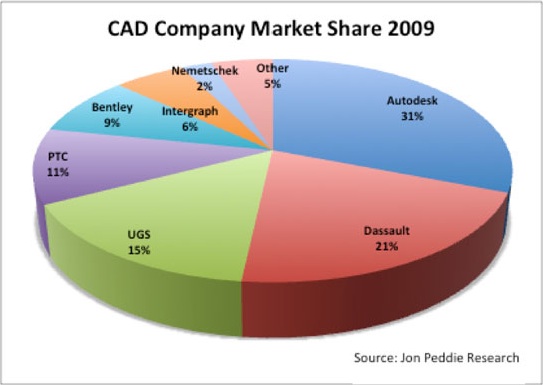
Updated Aug 2010
I noticed a lot of traffic to this page, and also noticed that the link to the report required a log in so decided to quote it here.
Let’s just get this over with: the year 2009 was a disaster in the CAD industry. According to our latest report, the CAD industry saw revenues of $5.1 billion, a 22% drop compared to 2008 and although the picture is improving for 2010, there is no rebound because that’s just not the way the CAD industry works, and worse, that’s not how this recession worked.
The CAD industry cannot turn on a dime because it’s part of larger systems. At this year’s Autodesk University, Carl Bass noted that subscriptions were down because there’s not much reason to maintain a subscription for empty seats. Unfortunately, there are a lot of empty seats for all CAD systems worldwide. We estimate that approximately 200,000 workers left the CAD industry worldwide. And, it can be added, we believe this is a conservative view.
In this latest report we have seen an interesting trend as Building Information Modeling (BIM) becomes accepted in the engineering, architecture and construction (AEC) industry. The similar discipline, PLM is just about ubiquitous in MCAD but as it was being introduced into the MCAD industry in the early 90s, it was essentially implemented in a top-down process as management signed up for the advantages that come with a consistent and connected data pipeline. In contrast, BIM in the architectural fields is being driven by those at the end of the pipeline in building and construction.
Business Rant : One of Many: #BIM #AIA
Posted by Jim Foster in architects, BIM, economic trends, Entrepreneurship on April 28, 2010
30%, that’s the figure that keeps coming back to me, business is down 30% and competitive bids are 30% less than what they used to be. I even had firms we do business with in India essentially say, “I am not going down the rathole.” You have got to be creative to deal with it. It reminds of a an accounting professor in business school who extolled, “all costs are variable,” not really but you get the point. Renegotiate rents, bargain with your workforce, create partnerships to fill holes, man it stretches the imagination which is good, however there is no reality like payroll, and rent, and insurance, etc. There was a recent article in the Las Vegas Business Press, “From Boom to Bust,” that echoes these themes. One GC stated that, ‘Our revenue in 2010 will be slightly less than half of what it was in 2008.” Bidders on projects have multiplied by 3, and successful bids seemed to be 40% below 2008 highs.
“Cash flow is the king during a recession,” Perini Building Co. Vice Chairman Dick Rizzo said. “As the economy shrinks, prompt payment is important. In some cases, it’s the only source of income to subcontractors and vendors.” This statement brings me to my next point, when did we ever, and architecture firms I am looking at you, get to a point where this statement is the norm, ‘you get paid when we get paid.’ Holy $$$$. This is patently ridiculous. There was a good article in the Boston Business Journal that said free lancers and sub contractors are spending as much time tracking down payments and getting paid as they did on the actual project. So looking at that vice of lower winning bids and taking forever to get paid what’s a small business to do? You can whine about it, not much help, or try and figure it out. I don’t even say make lemonade from lemons, this is strictly survive than thrive. To the ‘you get paid when we get paid’ again who ever agreed to that, but if your on the short end of that scenario consider starting a relationship with a factor, otherwise known a receivable financing, different companies specialize for different industries and even by size of receivables but there is one out there for you. They will take 1-3 points monthly but nothing like cash flow. As for some of the advice you get such as put penalties in your contract, talk directly to payroll, etc. most them will stay with the partly line, and a lot replace contracts you may have put together with their own which certainly does not have any late payment penalties.
As for multiple bidders and reduced winning bids, know your costs, use BIM, be ready for hard bids. It’s telling that GCs are the early adopters to BIM, Revit and the like and embracing their 4D and 5D aspects.
Partner up, can you still offer the same level or service as you could in 2008? Can you offer more today? More companies may be more willing to work together. Like I tell my kids, ‘the answer is always no unless you ask.’
Flexible BIM Pricing
Posted by Jim Foster in BIM, SaaS on April 9, 2010
 Graphisoft continues to lead with flexible pricing models for their BIM authoring software package, ArchiCAD 13. More popular overseas, Graphisoft first introduced their Star(t) addition priced at $1995 and now introduced ArchiCADRental (ACR). ACR allows users to flex into ArchiCAD based on need and essentially usage. Allowing users varying price points to get into a BIM package is definitely a good thing, I think the ACR model tests the waters for a demand / SaaS based model. Initially, the model allows for 1, 3, 6 month and 1 Year pricing models.
iPAD : BIM : Game Changer?
Posted by Jim Foster in BIM, New Technologies on April 8, 2010
 The launch of the iPad has brought a lot of focus back to the tablet or I guess we need to call it a slate. Nevermind that tablets have been commercially available for over a decade; however commercial success has always seemed to elude it. Lack of killer apps, increased expense compared to regular laptops certainly contributed but perhaps it was the change in the UI (User Interface) zeitgeist that provided a bigger hurdle. Apple introduced the world, in a largely commercially way, to the multi-touch interface with the iphone making many comfortable with the concept and its app store was a huge success with many programs priced around a $1 made it the equivalent of an impulse purchase at the Walgreen’s check out line. With the release of the ipad Apple has upped the ante, not just because of the user interface but with a mobile platform that is relying mostly on the web to deliver applications/data/multi-media/snacks/beverages much like the ‘thin-client’ devices promised to us in the nascent days of the interweb. So the question is does the iPad have the power/features/connectivity to matter in the A/E/C Industry, and if so who needs it as an always on, apple form factor in the field?
Processing power and GB of RAM, BIM tools are hogs so any true BIM authoring software would have to run remotely and accessed through the iPad or similar slate, and then the bottleneck becomes the latency in the broadband connection, in this case, most likely the 3G connection unless you have public wifi on your job site. And that would bring us back to something like Project Twitch from Autodesk which allows you remote control their products through an internet connection, since I don’t have an ipad I can’t vouch yet for how that would work but having your project stored remotely and using the ipad to drive through it that starts to get interesting.
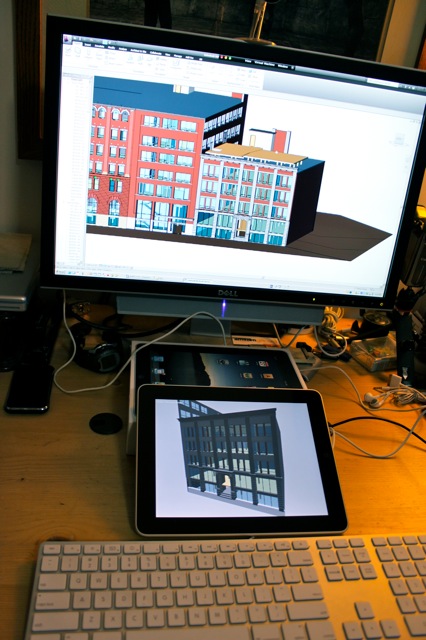
Screen Shot goBIM on iPad
goBIM which was released for the iphone, yes you read that right is running on the ipad. It is a BIM viewer that has an exporter API that will let you translate Revit and Rhino models into its own format. Why’s it’s own format? Visit the site for the FAQ and explanation but it seems as it matures the developer wants it to be an xml format.
One company focused on bringing BIM to field, an aptly calling it FieldBIM, Vela Systems blogged about the ipad, and beyond reiterating iPad specs and blogosphere pronouncements ends with a ‘we’ll have to wait and see.’ One of their  prerequisites though was a field case which is already available at HardCandy. Additionally, they have partnered with Motion Computing to provide ruggedized tablets for the FieldBIM. However, what we all just really want is to unlock data that is stuck in file rooms or servers and be able to interact with it in a meaningful way which seems to be Apple’s sweet spot.
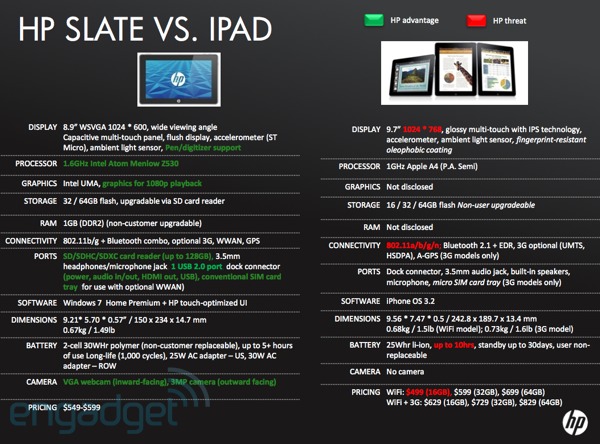 Counterbalancing Apple’s offering is the new HP Slate, which is essentially a slate wearing Windows 7 clothing and I am not sure how compelling an argument that is going to be as we’ve had a tablet edition of XP for a long time, is a multi-touch version going to sway a lot of people? Comes down to the applications and how they are served? If they are running remotely, who does the best job with the interface because the slate/pad whathaveyou is just the conduit. Which brings us to what might be the real game changer and that is the Google Chrome OS, open source/operating system, which doesn’t care what device you use and will just deliver it, this web centric open model seems more in line with our egalitarian nature and should increase adoption. But what keeps nagging at me is Apple’s tremendous execution and if their closed ecosystem produces field tools for the laymen then they got something going on, maybe break the functionality into bits, collision bits, scheduling bits, so the app provides not just the CM with a tool but workers who can use an app designed for their function, punch list, update, done. And that has been the beauty off the app store, essentially singularly focused bits that are easy to understand and implement. So if we have the true BIM up in a cloud and all these specific apps interfacing with it, that would be the equivalent of the web with user generated content (UGC) driving the system, and not the bloatware cloud we’ve been living under. It will be in the execution, otherwise you might be seeing people treating them more like Daniel Tosh did.
Spin Cycle BIM: UniMac Adds BIM Library
Posted by Jim Foster in BIM, economic trends on March 31, 2010
BIM contin ues to cross pollinate industries. According to American Laundry News (I’ll read it so you don’t have to) UniMac a manufacturer of on premise laundry equipment is now providing BIM objects of their most popular models. This, of course, allows the AEC community to incorporate them with their designs from a spatial sense and also coordinate utilities for hook up. Ideally warranty and manual information is tagged to the object as well so one object becomes a one stop shop of information, maintenance logs, etc. The bigger idea is what’s your BIM strategy? As the internet opened up a world of information about, well, everything BIM is opening up a new world of information.
I equate this next step in the internet and technology from going to the big bang, ‘wooaha new universe’ to galaxies to planets and these are starting get populated with more information and relevant data. The AEC industry is starting to break down from macro trends, etc. the complete life cycle of a building and how each decision effects it. There is a world of information and opportunity within this world. For example, UniMac just made it easier for a designer to spec their machines. What company wants the contract to keep the data and maintenance logs up to date for those machines within this BIM world, who wants the actual maintenance contract and which companies are plugged into take advantage of that entire life cycle, not just the building but almost every object in it.
Balkanized BIM: IPD -> VDC -> HPBMS -> Lean -> LPDS
Posted by Jim Foster in BIM on March 30, 2010
What the… It’s like alphabet soup and it’s also like the wild west out there, everyone staking their claim, evangelizing, growing their camps…but what’s it really mean. To me, and I’m lucky as we provide mostly the BM, not a very attractive acronym I realize as soon as I type it, but we provide the building model and then there is a whole lot of work to fill in the ‘I’ (Information) but what my position does afford me is to see how people are using these tools, how they understand them and what they hope to accomplish, but first lets decipher the soup and to me they break down into the majors (concepts) and the minors (processes).
Majors
BIM – Building Information Model.
VDC – Virtual Design and Construction
IPD – Integrated Project Delivery
Lean / Lean Construction
Minors
HPBMS – High Performance Building Management Systems
LPDS – Lean Production Delivery System (not sure I should have added this one but it came out Lean Construction Institute) and, well it fit well into the schema.
Well, what’s the point? I will go back to quoting a GC we worked for, who was one of the first to ask us for a Revit model of an existing building. ‘We now have the time and inclination to do things right’ This was as the real estate bubble was bursting, bids were more competitive and clients asking for hard bids. Loans had dried up. The old ways of doing things just did not seem to work or feel right and the lowest hanging fruit was putting together a building digitally, go over design options, costs, maintenance costs of those options going forward, operating costs for your choices, choosing, unearthing design problems digitally before a shovel hits the round, minimize change orders, get a building up quicker, for less money, and of equal or better quality with a firm assurance of what that building might cost you to run in the future, as the total life cycle costs of the building end up dwarfing the costs to build it.
So put any wrapper around it you want but it is about building digitally, communicating with your peers, subs, and anyone else who has a stake in it and getting it done. The playbook? Well that’s where we see all the acronyms come in and consultants forming and practices starting to help guide firms through this. My experience has been that GCs were the first to really adopt this, and the good ones have been through it, at least from the construction end, but there is a lot more learn, streamline and go through before there will be anything close to best practices (digitally) across all disciplines so I hope you like soup…But in the end, it’s like grandma says, ‘it’s good for you.’
Repeat after me…Sustainable Retrofits : #BIM #AIA #LEED
Posted by Jim Foster in Adoption, BIM, Built Environment, economic trends, Energy Analysis, Green on March 10, 2010
Within the last week I have been called, e-mailed and gone out to discuss sustainable retrofits. The logic for it seems unassailable and I included some quick stats at the bottom of the posting. However, as with the rise of virtual construction this is starting to make more sense to most that this is a real economic opportunity. What’s the cause, not sure if it’s the natural progression as companies look for opportunities in this environment, a truck load of AARA and TARP funds have hit, the Clinton Climate Initiative is creating traction, or a lot of hemp wearing hippies have hit the boardroom, however I believe the first penguins have slid down the ice and the rest of the waddle / rookery / herd is starting to follow.
Additionally, more hard data points are becoming available to assist. The Empire State Building has started a massive $500 million renovation and hopes to reduce its energy cost up to 38% annually or $4.4 Million. ‘Wait, you say’ Even I know what looks like to be a 100 year payback seems insane, why spend the money.’ If you look more closely and as they point out at the website that additional improvements on already planned upgrades cost $13.2 million, so $13.2 million yields the saving and payback in less than 4 years. The Chicago Mercantile Mart and its 4.2 million SF of showrooms, offices and and tradeshow space earned LEED -EB (Existing Building) Silver. While a video of Kong climbing the Empire State could be more compelling I included the promotional video as possibly more informing.
Inside the video at about 2:05 they talk about energy modeling. I wish they included what they used to model it, but if we start talking about scenario analysis and ROI we start talking about BIM again, and various companion products like EcoTect and IES. One of the bigger points made is that the time to do these things is by piggybacking on top of already planned improvements. But from low flush toilets, to new digital controls, reglazing windows, to chiller retrofits new ROI models are inviting and this strategy/offering has to be, absolutely, be in your quiver.
Some data points I found while researching this post.
Excerpted comments from President Obama speaking at the Brookings Institute are as follows:
Speaking about AARA funds the President said “is put Americans back to work doing the work America needs done, doubling our capacity in renewable energy’
‘Clean energy projects will all be ramping up in the months ahead’
‘I’m calling on Congress to consider a new program to provide incentives for consumers who retrofit their homes to become more energy efficient, which we know creates jobs, saves money for families, and reduces the pollution that threatens our environment. And I’m proposing that we expand select Recovery Act initiatives to promote energy efficiency and clean energy jobs which have proven particularly popular and effective.’ Full Transcript Available Here
Buildings and Climate Change – Quick Stats:
- Buildings Account for 38% of CO2 emissions in the United States —more than either the transportation or industrial sectors
- Over the next 25 years, CO2 emissions from buildings are projected to grow faster than any other sector, with emissions from commercial buildings projected to grow the fastest—1.8% a year through 2030
- Buildings consume 70% of the electricity load in the U.S.
- Buildings have a lifespan of 50-100 years during which they continually consume energy and produce CO2 emissions. If half of new commercial buildings were built to use 50% less energy, it would save over 6 million metric tons of CO2 annually for the life of the buildings—the equivalent of taking more than 1 million cars off the road every year
- The U.S. population and economy are projected to grow significantly over the coming decades, increasing the need for new buildings – to meet this demand, approximately 15 million new buildings are projected to be constructed by 2015
- Building green is one of the best strategies for meeting the challenge of climate change because the technology to make substantial reductions in energy and CO2 emissions already exists. The average LEED® certified building uses 32% less electricity and saves 350 metric tons of CO2 emissions annually
- Modest investments in energy-saving and other climate-friendly technologies can yield buildings and communities that are environmentally responsible, profitable and healthier places to live and work, and that contribute to reducing CO2 emissions
Source:  USGBC (US Green Building Council) and ASHRAE ( American Society  of Heating, Refrigerating
and Air Conditioning Engineers), the AIA,  IESNA (Illuminating Engineering Society of North America)
and the DOE.
3D from Photographs : #BIM #3D
Posted by Jim Foster in 3D, BIM, Built Environment on February 23, 2010
The world wants an easier way to get 3D. Photographic manipulation has been around for awhile. I remember sitting in a presentation by Yonald Chery for Mok3 which created photo immersive 3D, and this was back in 2004. The technology is still used today in something called supertour. A quote from 2004 at the time-
“This Mok3 thing could be bigger than SketchUp, especially for interior designers and architects,” Geoffrey Moore Langdon tells me. “It is like a PhotoShop that allows you to push-pull the images into correct 3D with the ease of SketchUp. Thus from a single photograph, you quickly create a 3D model:
It was ahead of its time, but we are seeing more entrants into the field. Autodesk acquired RealVIZ and its Image Modeler software, you can view a demo here. And today in the NY Times today there is the article Computers Turn Flat Photos into 3-D Buildings. Where they are using a crowd sourcing/social media aspect to data collection and improving the algorithms to stitch this stuff together. A project out of Cornell and University of Washington morphed into Microsoft’s Photosynth where you can view 3D images that have been stitched into “quasi 3D” through a browser. However, Photosynth appears to be limited by the number of photographs and data so the bigger desire was to scale this thing. So the same folks have been crunching more numbers and algorithms to create a more robust platform and a web site called Photocity was created entice people to add data and create the digital 3D construction of the WORLD, okay maybe not the world but then again…


