Posts Tagged BIM
BIM on The Front End : GC’s Paving the Way :#BIM
Posted by Jim Foster in BIM, Revit, Virtual Construction on November 2, 2009
Most likely if you’re reading this post you’ve drank the cool aid and believe in BIM and Revit, you’re a convert, but what has been come fantastically apparent is the need to educate the need for it on the front end, and why the 20/80 rule may not apply, that is 20% soft costs, 80% building. We have seen where productivity has been stagnant within the construction industry, because more elaborate buildings, systems, etc. using the same technology for scheduling, drafting, design negated any other positive gains. On the flip side people are reporting such massive prodcutivity gains by using BIM and Revit you would think that any owner/developer would be demanding it on the front end and willing to pay for it, cue the GSA, State of Wisconsin, State of Texas, etc. However, there is still a huge knowledge gap.
GC’s are paving the way for BIM. They know that in order to do the work that is being created they have to be on board with Revit and BIM and they will be the ones ultimately responsible for the task, coordination and updating of the BIM.
The GC will use Revit as a cost savings tool. How does this effect the developer/owner? Might be invisible to them, as in, the process works like they expect it to, more often than not projects coming in on-time and on-budget, more competitive bids with firms knowing they can reduce problems (see zero defect building) digitally, and schedule better. It’s a nail gun instead of a hammer.
Which brings me to the legal liability side of BIM, which I know nothing about but feel like I need to comment on, and I will tell you why.
I was preparing for a meeting with a University we did some work for, as they wanted to see what Revit could do for them as they asked for existing conditions plans in Revit just so they had the information/data about the building. This was an architectural BIM with an RCP. I called a friend who has nice sized GC firm that does a lot of academic work and asked if they could share some success stories about using Revit that I could share in my presentation.
He put me in touch with their MEP coordinator, who first told me his history. He had his own HVAC install company for 20 years, went back to school to be trained in AutoCAD, and got other certificates (too many acronyms for me to remember), and then got trained up in Revit 2 years ago. He had been with this firm for 10 years, so figure at around 50 he’s knocking this stuff out of the park. He explained how he used to coordinate all the plans in AutoCAD, put each discipline on a a different layer/color and then go to work determining the issues in 2D. Using Revit he would model everything in 3D, and since he was from the industry knew drain slopes, HVAC runs, etc. and without using collision detection software was finding stuff, such beam penetrations and drains intersecting with footings that you could imagine a ton of time/money. GC’s will use it because it is a better tool.
Here’s the legal part for those of you scratching your head. In his most recent project the architect said they had modeled the whole thing in Revit but would not share the model with him and only sent out the 2D plans. Somewhere there’s a screw loose and it has to be on the liability front. His thought was they were using young modelers that were not grounded in the profession so the interaction between everything would not be completely apparent to them so assumptions when modeling were not correct. The contractor themselves might want to model it themselves because they would then have more confidence in the model. However, when #1 cost for interoperability which is in the billions is the manual reentering of data you would hope this issue is being worked on to be resolved.
How’s this breaks out financially between firms and how much of a building’s cost moves to the virtual construction department? Well I’ll start digging but if any reader out there has some data please post, as it will help us all sell projects.


CAD Marketshare : BIM Marketshare : Installed Seats : Installed Base : #BIM #CAD
Posted by Jim Foster in 3D, BIM, CAD, economic trends, Installed Base, Installed Seats, Revit on October 22, 2009
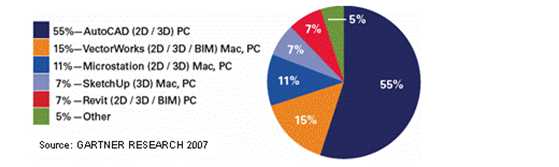
I thought I’d share some numbers here since I find it difficult to find them openly out there on the interweb. I included a Market Share Pie Chart which appears to be from Gartner Research circa 2007. Using the 55% AutoCAD figure for the total market share and using the AutoCAD installed base via 2008 of 4,162,000, which is right from an Autodesk Press release, we then can approximate the total installed seats for CAD (2D, 3D, BIM) to be around 7,567,273. However, this figure could be derived by revenue which will distort the total installed seats figure.
If we assume that 7,567,723 figure is correct, as well as the 7% figure for Revit provided by Gartner we get installed seats of Revit to be 530,000, give or take. That seems kind of close to the back of the envelope estimates I was coming up with by getting published accounts of installed Revit seats to be around 400,000 end of 2008, and they were selling new seats of Revit at around 20,000 per quarter, would have them around 480,000+ by the end of this year 2009. If installed seats of Revit have not surpassed the installed seats of AutoCAD Architecture, previously Architectural Desktop, it has to be getting close, as of 2008 there was an installed base of ADT/ACA of 503,000.
Using the report as a guideline they had BIM growth at approximately 12%, if Revit is adding seats at approximately 20,000 per quarter that is a 15% gain from FY 2009. In 2008 they had an increase in revenue from Revit from the previous year of 23%, which could be attributed to sales of subscriptions and on going maintenance contracts above and beyond the 15% I came up with here.
Another interesting fact is that as a percentage of revenue 3D Products and AutoCAD itself were getting very close to parity, with AutoCAD and AutoCADLT at 32% and 3D Products at 30%. I am not privy to how they break out all the figures but Civil 3D, Navisworks and Revit are all thrown into that bucket. So 3D solutions has gone from 23% of FY 2008 revenue to 27% of FY 2009 revenue to 30% at the Q2 FY 2010 watermark.
Some other information I found in an article at Architosh, and I have posted some of it here.
Revenue and Growth
According to JPR’s research, CAD software vendors saw combined revenues of $5.2 billion (USD) in 2007 globally. The CAD software market grew by an astounding 20% in 2007 compared to 2006. Despite a very poor US economy and the threat of US recession, the CAD industry will continue its positive economic trend and will grow to over $6 billion (USD) in 2008. Looking out five years the global CAD software market will reach and exceed $8.2 billion (USD).
2D and 3D
In 2007 the worldwide installed base of CAD users reached 5.31 million. In 2007 the majority of CAD users (63%) are still working in 2D, while 37% work in 3D. However, revenues for 3D CAD surpassed 2D CAD taking 53% of the market. This trend will continue but JPR makes note that not all 2D CAD users will make a transition to 3D CAD.
The article was based on the research from Jon Peddie Research.
To look at the 2007 figure of installed seats as reported by Jon Peddie, of 5.3 Million and a 15% Growth Rate we would get approximately 6.09 Million Users in 2008 and 7.00 Million in 2009.
Hope this was helpful for those of you at their searching for this stuff, and if you weren’t I don’t know how you got here and why you’re still reading.
BIM: Do you use it on a house? Do you use it here or there? I won’t use it Sam I am! :#BIM
Moral of the story, Sam likes it. Trolling through the variety of posts and discussion boards I came across this one about Is BIM the Future. And if we take a step back we should ask is 3D drafting the answer, which I think everyone would answer with a qualified yes. Working in 3D just makes everything faster, for presentations, for communicating with the clients, renderings, etc. Hell I even heard the comment that architects who would not touch CAD, are using SketchUP, and since they are SketchUP is gaining traction in the marketplace. BIM it is not, but communicating in 3D, it’s a snap and who wants to be against google. So if we are going to work in 3D, why not implement all these great tools and data which is essentially what BIM is. However, everyone is trying to jump, well not everyone, but most are trying to jump from a 2D world to try and fully implement BIM, and without getting your bearings in 3D first it’s a bit harder. Trying to implement a fully realized BIM, 4D-5D, Google-D, much tougher.
… baby steps get on the bus, baby steps down the aisle, baby steps…
But still I think you got to get started somewhere, because the expectation is you will have to deliver BIM, even if a lot might not be able to define it, but at least 3D. Recently someone asked us for a proposal on 120,000SF building to an existing conditions / as built survey to which I gave him a quote, he then asked what file type to which I replied that it was for 2D CAD / Floorplans. He then said I’d like in Revit. To which I replied, that would be more. His response, “Why?”
It will be the the coming expectations of everyone out there, and what’s tough, even with the all the ROI Case Studies of spending more money on the front end, very few want to do it. We are very early in the process of selling BIM / Revit to the masses so education is still going to be a big part of it. To get back on topic, is the future BIM? Yup, but were going to have to do a lot more selling and educating for it to pay for the firms creating them.
Acquistions in the BIM Space: ARC acquires RCMS Group: #BIM
Posted by Jim Foster in Adoption, BIM, economic trends on October 14, 2009
ARC a publicly traded company focused on document and digital management has acquired certain assets of the Atalanta based, RCMS Group. While on the macro level its good to see the markets waking up with acquisitions, etc. but a document management company acquiring a CAD/BIM Production shop. This backs up an earlier post when I spoke of the building as the operating system, and as companies have been creating running inside salesforce, and facebook, we will see a centralized BIM become the hub for a variety of services and value added services, from bidding on construction, to energy anaylsis, etc. and it seems to make a lot of sense that a company that focused on Digital Document Management is getting into the space. I wonder when Iron Mountain makes a play? Additionally, how many BIM production shops are out there and who is creating and maintaining content? With the official announcement by the GSA for the BIM awards, those prime contractors and their subs provides a good who’s who in the US BIM market.
Official ARC Press Release Here:
Checking out Wrightsoft : #MEP #BIM
Posted by Jim Foster in BIM on October 5, 2009
I had the pleasure of sitting down with Bill Wright of Wrightsoft the other week, and although my focus has been squarely on the creation of architectural BIMs, specifically from an existing conditions / as built perspective I was really impressed with what they are doing. While working in 2D the amount of meta data contained in the lines is amazing, along with the inherent logic of their drafting tools makes it an impressive package. Bill was driving through the software and showed how spaces without an adjoining space was assumed to be an exterior wall, and the levels, which has a very similar hierarchical/navigation structure uses information from the other levels to create its calculations. This is powerful analysis and HVAC design software that can provide what type of plant you might need and if you throw a window it will automatically make the duct wider for increased airflow and then create the build list. With all the talk about BIM, Bill and his crew have been providing its benefits in 2D for years. Meta Data, Analysis, Scheduling, Build Lists, etc.
Project Twitch : #Revit #SaaS #Cloud, Cool
Posted by Jim Foster in BIM, cloud, Revit, SaaS on September 25, 2009
So I had been ruminating in a post awhile back about using Revit and or BIM authoring tools as a service, Saas , or computing in the cloud. If you have been to any business or venture conference in the last 18 months+ inevitably someone will ask you what your SaaS model is, or you’ll hear the word cloud more than it’s repeated on the weather channel. Well sometimes you can tire of this chatter and discount it but this makes sense, rather than devoting your time and resources managing hardware boxes and upgrading software, etc. it makes more sense to just go to work. Wit regards to the BIM world, you want to have the BIM centrally stored and distributable, I mean this model makes more sense to me for BIM than most. So in comes Project Twitch from Autodesk, which is the “remote delivery of (Autodesk) application over the internet..” and included in the test is Revit Architecture 2010. For latency reason they say you should be within 1000 miles of the test lab in San Fran…really? slackers. This is a very good thing.
BIM Usage Increases 75% : Autodesk Stock Up over 100% in 6 Months : The Business of #BIM
Posted by Jim Foster in Adoption, BIM, Existing Conditions, Revit on September 25, 2009
Hey we can all bend statistics in our favor but the one that jumps off the page in the most recent McGraw Hill Smart Market report is that one-half, 50% of the industry is using BIM, or a 75% increase in usage in the last 2 years. That’s a ridiculous adoption rate. McGraw Hill’s method of analysis is through internet surveys and while you can question the sample population the broader market may have picked up on this as well as Autodesk, the defacto 800 lb gorilla with Revit and Navisworks, etc. , is off its 5 year low posted on March 9, 2009 of $11.79 to trading at $23.58, that’s 100% gain folks in a little over 6 months. If you are new to this world you think everyone has drank the cool aid but if principal, CM, PM, etc is making the decision on what/when/where to invest in BIM is becoming a too obvious choice even if its just to be on the bandwagon. Anyone who has pulled CAD lines until they cramped up and laments changes and design options knows the beauty of working in 3D.
So not surprisingly one of the most repeated benefits is “reducing rework” and “avoiding rework”, you see the trend and this jibes well with all the other reports we have seen and also noted here, including the estimated $16 billion to $34 Billion wasted on such things. But while that becomes the most apparent most immediately the effects of everything else downstream cannot be discounted, integrated disciplines, collision detection, scheduling, the “zero-defect” building. However, can’t get there until you start with BIM. Existing Conditions, Renovations, New Construction, it does not matter as there are technologies that will help get you there.
Report is Available Here through McGraw Hill
Revit and Rockband
Posted by Jim Foster in BIM, Built Environment, GSA, Revit on September 16, 2009
No the two do not have anything to do with each other but just describing my day. It started to get on the road early to get to a site an hour away where we are creating a Revit model of an existing building. The building has 5 structures inter-joined over the years with the oldest dating to 1761 and the youngest being a large addition in 1984. Multiple construction methods, floor levels, etc. make it a challenge but utilizing our PPLT (Point to Point Laser Technology) made the base model creation pretty quick, considering. I then realized I signed myself up for two engagements, one was the Boston Revit User Group meetup hosted by Shepley Bullfinch and the other other was a Tech Tuesday hosted at Microsoft’s NERD (New England Research Development) Center, clever, no?
I was impressed with the meetup group because you had a large amount of people from different companies and disciplines discussing Revit and best practices. While I was only able to stay for one of three presentations everyone was open in discussing the project and how they went about it, how to set up projects for programming and even rendering tips were coming out of the audience. I think any environment where people are freely sharing ideas a great place, and it seems Revit and BIM requires this kind of collaboration and it was refreshing. I then hustled across the river to Cambridge and the NERD center to see what was up, collect my free drink ticket and take part of the free pizza. Harmonix was there and had set up Rock Band- Beatles on the main part of the floor which was being displayed on a huge screen, I would recommend playing rock band in this format if you can swing it. Lively crew and I saw some gray beards walking around which I believe were some of the original engineers at BBN.
Also found out the first project from GSA award should be out by Friday. I feel fortunate to be part of the team that won one of the awards but its going to be interesting to see how the multi-disciplinary jigsaw puzzle is going to be put together. And got a call from Australia, at my house, from a person about PointKnown, the pencil scratched note from my wife mentioned ‘distribution.’ Saddle up.
Towards a BIM Paradigm
Posted by Jim Foster in Adoption, BIM, Uncategorized on September 12, 2009
Interesting article in Architecture Week, Toward a BIM Paradigm
BIM Cloud : #BIM #Cloud #saas
Posted by Jim Foster in BIM, cloud, SaaS on September 12, 2009
The idea of BIM and IPD is a fantastic one but the biggest goal that remains is getting all disciplines working within the same BIM. Today there are multiple products that perform a wide variety of tasks from BIM authoring tools, like Revit, to energy analysis packages like Ecotect and IES, and integration tools like Navisworks. To facilitate cross communication file formats and schemas have been introduced like IFCxml, GBxml, AGCxml, etc. How is one to understand let alone implement best practices? While the options makes ones head spin there are corollaries in the software world and well established ones at that can help guide us. For simplicity sake I will use the one I am using today to publish this blog. The software or authoring tool I am using resides on the internet, or in the ‘cloud.’ It is saved in bytes and I continuously misspell words it helps me correct them. This blog also automatically publishes to twitter because of a plug-in I installed and if you are reading this it is because it was picked up by an RSS feed, or keyword alert, or through a google search, etc. The data can then be diced up and delivered in a variety of ways that serves the most value to you. This example holds true across all data. Facebook, Salesforce, etc. are all platforms that allow you to distribute and interact with data that resides in the cloud because people smarter than me have written programs designed specifically to do a particular task. Imagine interacting with a BIM in the same way. Imagine ripping of data that is important to you without having 5 different programs installed and each needs to be translated into the next. This is why the idea of cloud computing and SaaS are so powerful and prevalent in the marketplace today. There are firms working on this today and when they become widespread and put into use we will see the promise of BIM become a reality.
A couple of examples are linked below.
Towards a New BIM Paradigm, Architecture Week
A model server example and open architecture
Don’t we want to see as many programmers as we can working on the problems effecting us as possible? The more plug ins and apps we have working in an open environment, the better.


