Posts Tagged Revit
3 Myths About Laser Scanning and Point Clouds for Architecture and the Built Environment
Posted by Jim Foster in Built Environment, Laser Scanning, New Technologies, Point Cloud, Point to Point Laser Technology on September 16, 2013

Are laser scanners and their resulting pointclouds right for you and your project? As with all lists, it is simplified and of my opinion. Whether you want to trust my opinion, well that’s up to you, but my company Interioreview has, for over a decade, surveyed / drafted / modeled hundreds of buildings and starting in 2006 delivered Revit Models of existing buildings. My company, PointKnown, has created an Add-In to Revit that allows you capture and model buildings as you measure, in real time with a hand held laser. Now that I’ve blown my own horn here are my top 3 Myths:
It’s Foolproof and Error Free.
Wrong. I have not once received a model from a ‘pointcloud’ surveyor without dimensional errors in the model. Not once. Only because of our internal controls and surveying was I able to call out the errors and was not satisfied with other companies internal controls that the errors would have been found if my company had not found them. Such that we now will do all the modeling in house. Just because someone has a scanner does not mean they do it well.
it is concluded that features such as reflectivity, color, and brightness of the object surfaces have impact on the quality of the data, therefore, although 3D point cloud data is very useful it should be considered that the data can be sometimes irregular and corrupted and thus not exactly reflecting the features of the scanned object.
It’s Easy to Produce a Model From a Pointcloud.
Holy cow, no. How many technologies come into play to get a scan created, consolidated, registered, exported, modeled? First the hardware/scanner, whether it’s from Leica, Faro, whoever, they have their own software to manage the scan/cloud, and then you can export/import to Revit to use as a background to model over. You can use other technologies to help with this process such as Scan to BIM, or to cut portions of the pointcloud you can use ReCap, export to Autocad and re-import that data into Revit, etc. My point being there are a variety of methods to get from here to there but they are not necessarily consistent and have their strength and weaknesses, but you are using human power to make those decisions at each step. And then you are essentially using the pointcloud to ‘trace’ over. That is, you cut sections of the pointcloud in what ever view you are working in and trace over them. Has the person ‘modeling’ the building ever surveyed a building? Or have construction or architecture experience to know how a building should be put together. Does the architect really want to see a wall with a .08 degree deflection of wall off 90 degrees because it will create numerous amount of Revit errors, and was it really there or was the pointcloud interpreted incorrectly? There is no easy button.
It’s Cost Effective
Putting a scanning crew on site for a day is going to cost you between $3K-$4K typically, just to get the exterior of a building, with the pointcloud only, expect at least a 2 day buy in for between $6K and $8K, and that’s typically without going inside, and at the end you get the point cloud, not a Revit model. So a typical house, modeled from a point cloud, inside and out, best guess $8K-$10K. 12 Story Commercial Office Building, $50K+ and so on. Maybe that’s in your budget, but if so why? Why would you need to spend thousands of dollars to be told a room is square and has a 10′ ceiling?
Once dealing with the pointcloud, if you are dealing with it yourself, I hope you have a box/computer that is going to have a minimum of 16GB RAM, multicore XEON processor, etc. and ideally has a solid state drive, this is recommended by Autodesk for ‘pointcloud’ interactions.
You as a consumer of this data need to know what technologies are out there, your choices and their cost. I have seen circumstances and white papers where laser scanning pays dividends many times over, most consistently in existing exposed MEP intensive facilities, think utilities, drilling platforms, power-plants and the like where having a accurate representation of all that data can allow people to retrofit power-plants with few change orders or zero defects. Imagine an offshore construction platform that can lease for $100’s of thousands a day finishing early because of the accuracy of data, very good investment indeed even if it costs $200K to model it accurately. However, do you need that kind of data for a commercial building or an adaptive reuse project? How are you going to capture the interiors? There are methods to capture the built environment accurately for your needs without wasting money and effort.
Conclusion
Start with the simplest model you need, dimensionally accurate, volumetrically correct using whatever technology that gets you there cost effectively and with a level of confidence. Adding details to the model should be done dependent on scope and need. Power-plant of a building, you may want to bring in a scanner to model the piping package, etc. Accuracy of a historic structure that you may need to impact because of a project, sure scan it, but to scan an entire project is overkill in many circumstances no matter what you are told. Scan where you need details added. Know your options. Your tool box needs more than a hammer.


We Now Have The Time and Inclination To Do Things Right : BIM Adoption Reaches 71% In North America
Posted by Jim Foster in Adoption, BIM on February 13, 2013
 “We now have the time and inclination to do things right,” this phrase was uttered by a client of ours, a construction manager, after the 2008 economic implosion of the real estate sector. The time portion was meant ‘unfortunately’ as few of us were as busy as we wanted, but what he was referring to was his firms move to Revit/BIM. It just did not make sense from a coordination or phasing point of view to work in CAD anymore because he saw the savings and potential advantages for his firm to move to Revit.
Now according the latest Smart Market Report from McGraw Hill BIM Adoption in North America has reached 71%; that’s up roughly 300% from 2007 when it was 28%. Give or take a few percentage points.
“I think there’s going to be a huge shakeout. Those who practice the old way are soon going to find themselves without work. Either change, get with this program or go out of business.” -Patrick MacLeamy, CEO HOK
Strong words, and I can’t say that the legacy tail of 2D is not a long one but the benefits of BIM are real, and if the reasoning for a firm not to make the move is simply, well we’ve always done it this way. It may be time to initiate a new planning regimen. Also in this report is information provided by JC Cannistraro, a MEP Constractor in Watertown, MA wqhich saw change orders drop from 18.42% when working with 2D CAD, to 2.68% with collaborative BIM, that’s as a percentage of total cost, and very real money.
Reality Capture, for Real. Autodesk Completes Capture of Allpoint Systems : #BIM
Posted by Jim Foster in BIM, Built Environment, New Technologies on February 7, 2013
 At the end of this month Autodesk announced it completed the purchase of Allpoint Systems, this adds to the ‘Reality Capture’ stable now including Alice Labs. Although much like the borg, you google Alice Labs and not much comes up as the technology and seemingly most of the talent has been absorbed into the mothership. As with the purchase of Alice Labs it does not appear that anything from Allpoint will be available for purchase anymore as the technology is incorporated into existing Autodesk products. From the Press Release:
The acquisition of Allpoint Systems reflects Autodesk’s continued investment in developing sophisticated, easy-to-use reality capture technologies. Reality capture is the practice of creating digital models of physical objects and spaces using photography, laser scanning and other technologies.
Why ‘Reality Capture’ or the ‘Documentation of Reality’, well let’s talk about cars, hang with me. According to our good friends at Wikipedia, there are about 254 Million passenger cars on the road or registered in the United States and compared to new car sales of almost 13 million that’s a rough ratio of 80/20, that is new versus used. Interestingly, last time I pulled numbers and the Boston Redevelopment Authority of new construciton permits vs permits for improvements etc. in existing space it was 80/20, in favor of the existing space. So, look where the work is done, used cars, maintenance, improvements, after market, selling gas, same for buildings, infrastructure (bridges, tunnels) etc. And the best way to start a project is to document building, bridges, etc. accurately. The smart money buys used. Or let’s have Autodesk PR Recap. “….continued investment in developing sophisticated, easy-to-use reality capture technologies”
5 Firms Converge on New Orleans to Document The Royal Sonesta
Posted by Jim Foster in 3D, As Builts, BIM, Built Environment, Existing Conditions on January 16, 2013
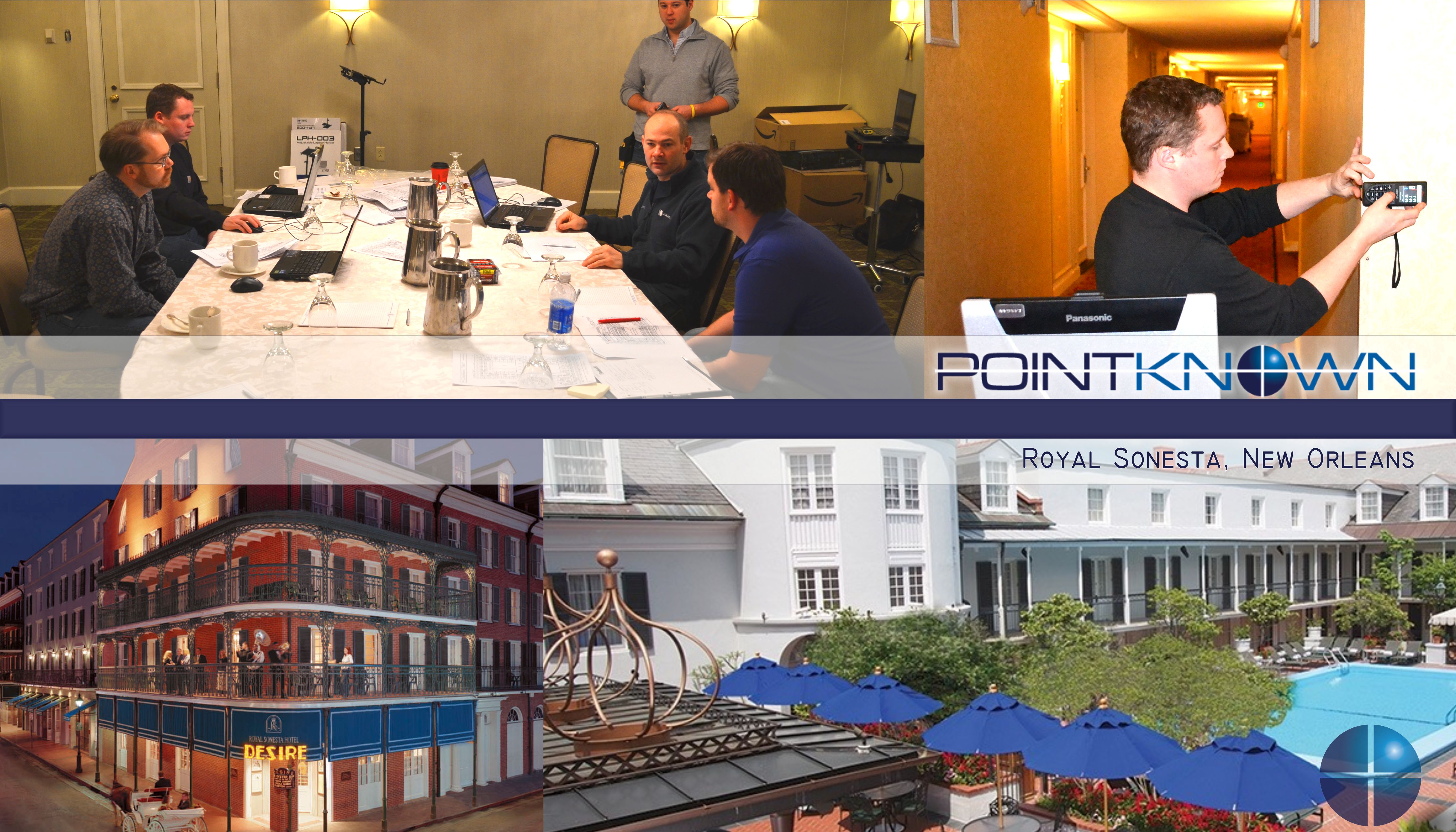 “Jim your a go….” 2:40 PM, New Years Eve 2012. Text from our client; Mark at Looney & Associates
Our work window was January 3rd through January 9 2013. Travel arrangements and team needed to be assembled for flights in two days. The only thread holding this together was PKNail Pro.
Team members included individuals from Langan Engineering, Turis, TrueScan3d, LandAir Surveying and my company Interioreview. The Job: Survey and Document Floors 2-7 of the Royal Sonesta Hotel, 300 Bourbon Street. Include structure, electrical objects (Duplex, Com Ports, Thermostats, Wall Lights, etc) and Fire Protection. 450+ Rooms, Common Spaces, Administrative Spaces, +200,000 SF. 1 Week. From Blank Screen to Floorplans and RCP.
“This is innovative stuff…”, Greg Jensen, Langan Engineering
“…Boom, your done.” Brady O’Brien, Turis Systems
“This certainly opens the door for future teaming efforts, and we’ve already begun to push PK Nail on some of our interior projects – integrating it with scanning and traditional survey.” – Paul Fisher, VP Langan Engineering.
This project could not have happened without the participating firms willingness to deal with such a tight deployment deadline and with the excellent individuals that arrived in New Orleans. It also could not have happened, and I do have a horse in this race, without PKNail Pro and Revit. There was simply no other way to coordinate multiple personnel field surveying without both. We were able to deploy resources as needed since everything was being surveyed and modeled in real time. 4th Floor, South Wing, Greg get on it. Brian, 2nd Floor with Nico etc. This also allowed us to create a punch list in real time. Reflected Ceiling on 3rd Floor, etc. as all the files were compiled daily, if not more often into a central file. Although the deliverable will eventually be in 2D Autocad, all the initial documentation will be in Revit, so even though it was not part of the scope, we will be able to deliver a typical section through the building with only a small post processing effort.
Lastly, thank you to the good folks at The Royal Sonesta, New Orleans for treating us so well. They understand hospitality and have a great team.
More and more firms are relying on PKNail Pro for documenting buildings whether they need the final deliverable in Revit or 2D Autocad. PKNail Pro can deliver.
Hey Microsoft I’ve Got Your Game Changer; Right Here
Posted by Jim Foster in BIM, New Technologies, Revit on October 24, 2012
 So when we demo our software, inevitably for a lot of architects we are asked, usually at least once, so will this work on the ipad? Fact is, not yet, not until Revit works on the ipad, which the only way I see that happening is that Citrix does an amazing job serving it through a 4G pipeline, so most likely Revit / BIM Models can be viewed in the field, but not yet interacting with one in a meaningful way. Yes you might argue there are check lists, etc. but I’m speaking about dealing with the actual authoring tool. So while architects ask if PKNail Pro works on the ipad. Salespeople will say, “Hey have you seen the Surface? That could be a game changer for you.” That is full blown windows working on a tablet that will run Revit in the field. The review by David Pogue in the Times, states the Surface “On the hardware front, Microsoft has succeeded brilliantly… amazing, amazing hardware. Now the heartbreak: software.” He argues that operating system is not here yet, but this is Windows RT. I’m talking about taking Full Blown Windows into the field for some serious heavy weight mobile application throw down. Building a Revit Model, a Building Information Model of an existing building, in the field, in real time with just your Surface Tablet, a laser range finder, and some software, some industry specific software that will make you 10x faster. Yes, I’m saying PKNail Pro will do that. It’s effective, it’s fast, and now let’s put a wrapper around it named Surface.
So Microsoft, send me a demo, if it’s what I’m expecting I’ll be singing your praises. It’s time to get to work.
*I’m serious Microsoft, so hopefully an identity manager has picked this thread up, or someone wants to make introduction. We are fired up for the Surface and not because we want swag but because it looks like its the size of a beach ball, teed up, and we’re swinging hard.
**Why a picture of LT? Well, it’s LT. Further defined: Left Offensive Tackles are now prized possessions in the NFL and some of the highest paid. That happened when LT lined up. LT changed the game.
New Windows Surface Tablet Puts Revit in the Field.
Posted by Jim Foster in New Technologies, Revit on June 20, 2012
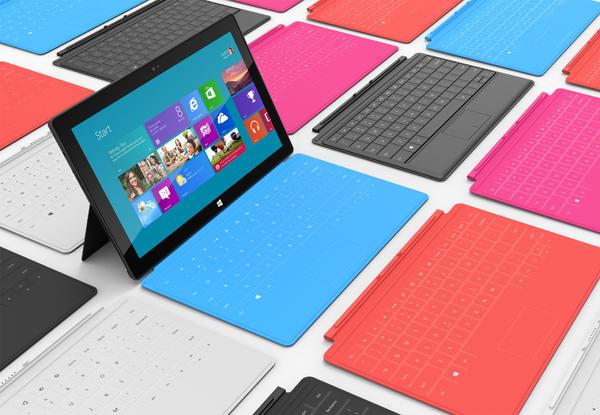 With Microsoft’s announcement of Windows 8, and the unveiling of the Surface Tablet, it finally appears there will be a tablet form factor that will run Revit in the field. According to the press release there will be two versions, one based on the ARM chip and another based on the Intel i5 chip running Windows 8 Pro. The iPad, as much it is great for so many tasks, simply does not have the horsepower to run Revit in the field, and delivering the type of user experience one would want with heavyweight programs is a real limitation in the ‘cloud.’ I understand Autodesk is now counting solely on Citrix to provide its remote platform but even if you are driving Revit remotely would you want to rely on whatever internet connection you have? That’s just not a funnel I would want to count on in the field.
At first glance you might say so what, not a big deal. However, if I can have a device that toggles between my heavyweight AEC programs, and delivers content the way my my iPad does then I might have an iPad to sell you; because frankly I am sick of devices, I live between the Mac and Windows camp, I’m tired of it. I used to be an Apple fanatic, even being the only kid in business school with a Mac, the disastrous PowerPC model, but what was not to like about Apple. Now, how did we get to the point where Microsoft is the little guy, relatively speaking. Now if they could get their content management into a spot that works the way you want. Imagine the central Revit model up on the sky drive, you check it out in the field, do your work, update it, booyah.
I think single purpose, highly specific apps are great to digest data, not for the creation of it so I am real interested in the melding of tablet like functionality with horsepower. I’m rooting for the little guy, I’m rooting for Microsoft.
********************
BTW anyone else bother to notice the blending and vertical integration of software/hardware. Apple, obviously. Google buys Motorola. Microsoft with multiple attempts, Zune, XBox, etc. and now Surface. And more germane to AEC Trimble buys Tekla and SketchUp. Seems to be the biz strategy du jour, watch for more.
For Those That Like to Tweet… A Free iPad
Posted by Jim Foster in BIM, Built Environment, New Technologies, Point to Point Laser Technology on June 13, 2012
 Tweet about PKNail Pro’s Proven Field to BIM Technology, Get Entered Automatically
PointKnown is giving away a free Apple iPad to one lucky Twitterer…er, tweeter, i.e. one who uses the service twitter to disseminate clever, witty, informative text burst in 140 characters or less. PointKnown does not claim to be clever, witty or informative, but will claim producing kick ahh…whup ahh…Excellent productivity software tools for documenting existing buildings.
How to Enter
To participate, simply tweet using the hash tags below:
#pknail #revit #bim and mention ‘PKNail Pro’
Examples
“PKNail Pro turbo charges Revit and modeling existing buildings #pknail #revit #bim”
or “Capture Existing Buildings Directly In Revit with PKNail Pro, 5x-10x faster #pknail #revit #bim”
less pertinent but still acceptable “We came, we saw, we conquered with PKNail Pro, #pknail, #bim , #revit”
less pertinent verging to the non-sequitur but still acceptable…
“beautiful software for happy people PKNail Pro, #pknail, #bim, #revit”
Remember: follow @pointknown on Twitter for the winner announcement:
We are on the road with Microcad and have other excellent resellers including, Seiler Instrument (ask for Harvey) and CADDFX
Legal Mumbo Jumbo
Rules & Conditions
1. This giveaway is offered by PointKnown LLC and is open to anyone with a Twitter account who is at least 16 years of age. Employees of PointKnown, LLC. and/or its affiliated companies and family members of such employees may enter the contest but are not eligible to win.
2. The giveaway will begin at the time of this post and end 62 days after initial post, a winner will be randomly chosen, much like the number 62, and announced via twitter through @pointknown
3. One giveaway will be available: a 16GB Wi-Fi Apple iPad or $499 Apple Store Credit, winner’s choice.
4. You must prove ownership of the winning entry and provide your email address to collect the prize.
5. To enter the giveaway you must send out a tweet from your own Twitter account that includes the #hash tags above in your message.
6. Entries using automated tweets will be disqualified, however there is no limit on the number of tweets you may enter.
7. PointKnown LLC will choose a winner randomly from all the entries within the specified period. The winner will be announced from our twitter account (@pointknown) once the contest ends.
8. Entrants agree to allow @pointknown to use their twitter handles and entry tweets for marketing purposes.
9. Neither PointKnown LLC. nor its affiliated companies shall have any liability for (i) any technical failures of any kind, including but not limited to malfunctions, interruptions or disconnections in phone lines or network hardware or software; (ii) technical or human error which may occur in the administration of the giveaway; (iii) any malfunction of or damage to the prize; (iv) any corruption, typos or hacking of prize winners email accounts; or (v) any restrictions or delays imposed by any customs authorities or any import or other taxes of any kind imposed by any taxation authority in respect of the prizes.
Interioreview Surveys & Models 28 Story DuBois Library with PKNail Pro
Posted by Jim Foster in BIM, Built Environment, New Technologies on May 15, 2012
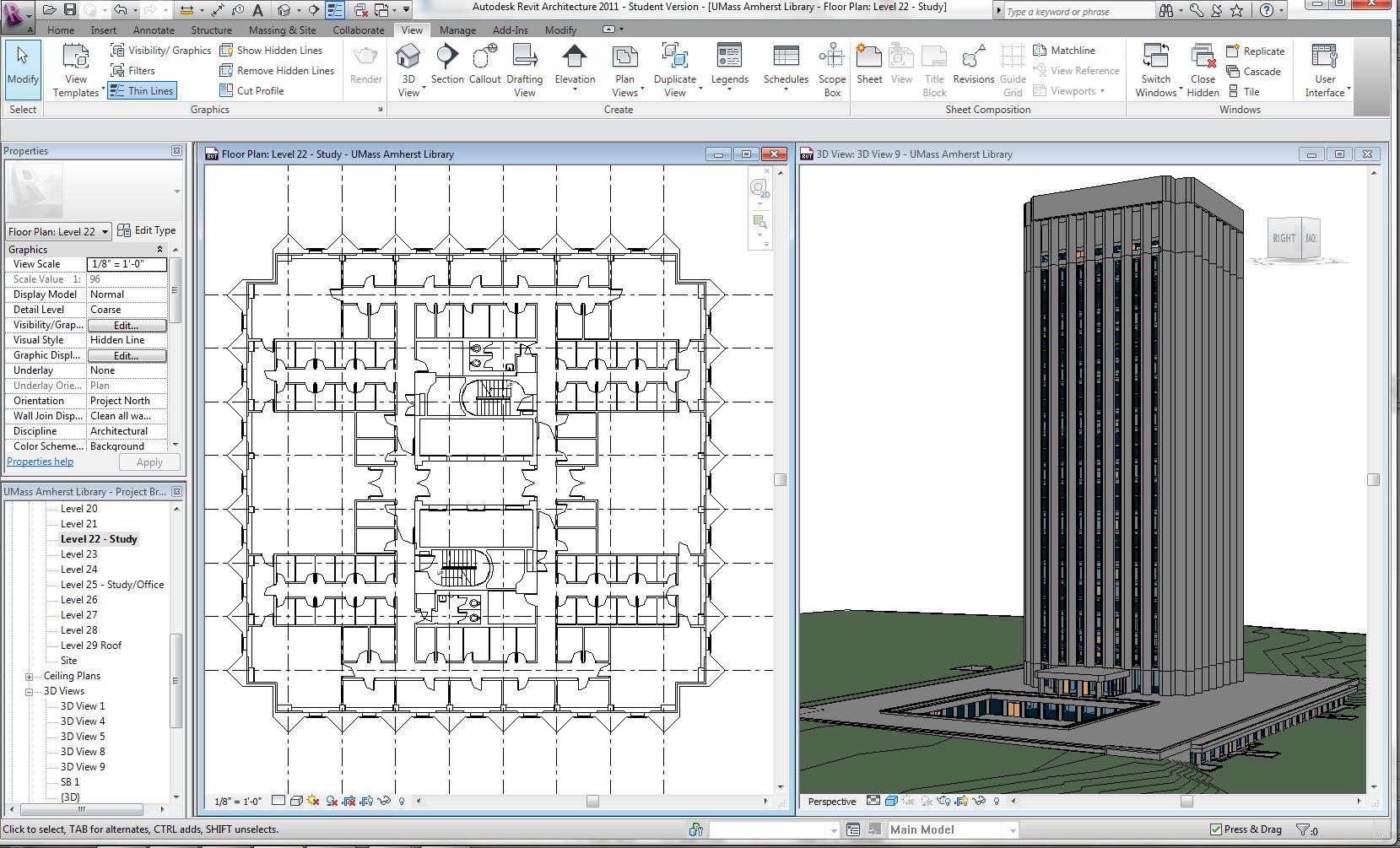
Interioreview, utilized PKNail Pro, an add in to Revit, combined with Leica Disto D8 laser range finders as the main surveying tool and software for capturing and modeling the 28 Story DuBois Library at UMass Amherst. The structure designed by Durell Stone in 1966 is tallest library in the United States. While intially considering combining LIDAR and creating a pointcloud for the exterior and utilizing PKNail Pro for the interior it turned out the exterior was the easiest part of the job and it was interior that was the most difficult. Every 3rd floor contained 90+ rooms with study carrels combined with classrooms where very few technologies would work well. Nico Martinez, a Project Manager with Interioreview, commented,”Without PKNail the survey work could have taken 5 times, 10 times what it was.”
The project was completed to support the design and retrofitting a fire protection system.
Interioreview, an architecural surveying firm founded in 2003 specialzies in documenting the built environment in both 2D CAD and 3D Revit formats.
PointKnown, a software firm, founded in 2008 develops productivity tools for the built environment / AEC (Architectural, Engineering, and Construction) Industry
PKNail Pro, allows a user to measure and model objects in real time directly in Revit.
Autodesk® Revit® software is specifically built for Building Information Modeling (BIM), helping building professionals design, build, and maintain higher-quality, more energy-efficient buildings.
Open BIM? Who really has a vested interest in the care and feeding of an open platform?
Posted by Jim Foster in Autodesk, BIM on March 14, 2012
 So straight out of Budapest….and Boston comes the PR Release of Open BIM. I am for Open BIM, I love the idea of working in a platform agnostic environment and make the building all about the data not the platform, however, when Open BIM is made up of a consortium of companies that have a vested interest in the process, such as Nemetshek, Tekla and Trimble at least the antennae are going to go up.
“Open BIM Programme is a marketing campaign initiated by GRAPHISOFT®, Tekla® and other members of buildingSMART® to urge and facilitate globally coordinated promotion of the Open BIM concept throughout the AEC industry, with aligned communication and common branding available to programme participants.” This is taken right from the buildingSMART website. Now buidlingSMART appears to be the outgrowth of the IFC initiative which was started by Autodesk in 1994, however, Autodesk now does not appear to be a part of this? Why not?
I think fighting against the hegemony of the Autodesk dreadnaught is okay but one has to a question an open standard in this space. As far as I know there is no open source BIM authoring tool, which would be super cool; so then who has a vested interest in the ‘open’ standard and supporting it? I know if I have an ancient CAD file I can still open it in AutoCAD because you have a for profit company investing in itself and it’s long tail, open standard? Not sure if it works. Would I be able to open a file that was saved in an IFC format twenty years from now? I can still open a Revit file that is 7 years old. Is this a capitalism vs. socialism equation? I would not go that far but there is a whole lot invested in software to design/manage buildings digitally so what does Open really mean in this case besides just a ‘marketing campaign initiated from Graphisoft…” As my dad always says, usually when you want to know the motivation for something, “follow the money.”
I’ve written about this before and I think in the ideal world the building, the BIM, is open and people just write apps for the model, as current apps put a nice wrapper around open data so can BIM apps. Need energy analysis, buy the app, space management, buy the app but the initial creation and file formatting lies in the BIM authoring tool, Revit, Archicad, etc. How does the centralized BIM server model work when changes are made, etc. and what file format is it kept in that will have the legacy to support it? Perhaps after the building is designed or existing building is captured in a BIM platform it can be translated into the IFC, whathave you, open platform and then becomes the defacto standard for existing buildings (EB), but during the design process? There are a lot of people with a vested interest to keep it in their ecosystem. Who will invest, support and nurture an Open BIM standard and to what end?
BIM….It’s like Legos
Posted by Jim Foster in BIM on January 12, 2012
 In an article in the Boston Herald Robert Murray, the President of Bond Construction stated that BIM sped up construction by 10%, or in the case of a current project at Boston University, 2.5 Months. The new building 122,000 square feet in all will be mixed use with restaurants, offices, and classrooms and comes with a price tag of $48 million. While the article mostly emphasizes the increased speed that buildings can go up, especially important in the academic community to get a building on-line for a new year, how about the cost savings? You have a full crew off the building 2.5 months early?
“In the future, we’ll build the whole building in sections, not just the systems,” he said. “That’ll be the standard, almost like Legos.” – Robert Murray – President Bond Brothers
The project manager mentioned that they analyze every piece of equipment that comes into the building to make sure it has a clear path. A giant room size air conditioning unit was checked digitally to see that it could fit.
“At the project office next door to the site on Commonwealth Avenue, Bond superintendent George Antonucci sat at a desk with five computer monitors running software such as Revit, NavisWorks and AutoCad that chelp model the building’s components. An iPad running an app called Vela Mobile lets workers take the 3D model onsite. All of that technology makes it possible for workers to map every duct, pipe and wire in detail beforehand, instead of fitting them as they build. “
“It’s a hell of a lot faster …..,” Antonucci said.


