Posts Tagged BIM
BIM Pricing : Graphisoft fires 1st Shot of 2010
Posted by Jim Foster in BIM on February 22, 2010
So there are always been a lot of water cooler discussions about the price of software, and in here at frombulator it would be the pricing of BIM software. With visual communication of clients still being the number 1 reason for people using the stuff, and not necessarily the right reason, it seems a less robust BIM, miniBIM piece of software might do the trick. ‘Hey, that’s Sketch Up’ True Sketch Up does a fine job of communicating visually with clients, however, I don’t know anyone putting construction documents together with it, although by saying that I’m sure someone out there will correct me. However, needing a first step with BIM without laying down $5K and 20% annually seems like there might be a sweet spot for an entry product. So Graphisoft issues a press release Feb 18, about the new ArchiCAD STAR(T) Edition with a suggested retail price of $1995. Is this big enough to warrant a response from the gorilla in Waltham, yeah I know corporate HQ i in California but Revit still lives closer to its ancestral home. I will be watching this because I usually ask somewhere in my presentations, ‘When I say BIM how many of you are thinking Revit?’ Sounds like the start of good poll, not sure who wants to know the answer.


Open Standards Across Product Lines : SPie Cookbook : BIM
Posted by Jim Foster in BIM, IPD, Open Standard on February 11, 2010
Even though the initial embrace with BIM was to visually communicate with clients and initially for me was coordinated and updated documentation the real carrot is the 4D and 5D aspects of the software, and real cost estimation demands components and products that are their real world digital equivalents, not generic components. This calls for an open standard that manufactures can write and specifiers can utilize. Thankfully there are people who know this and working to make it a reality. A recent meeting sponsored by NIBS / Building Smart Alliance was held this past December to discuss and come up with a road map to reality. The Specifiers Properties Information Exchange (SPie) Meeting came up with a cookbook to address it. The fact they hope to have standards in place for all major building products by December 2010 is a great and ambitious goal. The home page to the session is available here and has other links to good information.
Excerpt
What is driving this project?
Many project stakeholders have been asking (some demanding) that building designs contain explicit properties about the objects in the building. To ensure that individual software vendors, large owners, or large manufactures do not begin to include proprietary requirements in open standard information exchanges, the SPie project was formed.
What are the next steps?
Now that the recipe for SPie has been created, NIBS is conducting an outreach effort that will result in a spring 2010 meeting. The purpose of this meeting is to allow a wide range of trade associations to engage with the project as quickly as possible. Our goal will be to have complete templates and product property data sets be available across the majority of building products by Dec 2010.
Private Cloud BIM
Posted by Jim Foster in BIM, cloud, SaaS on February 10, 2010
Excellent article from Chris France on AECBytes on how Little Diversified is using Private Cloud Computing to deliver cost savings across its organization and powerful computing to its designers.
Excerpt below but well worth the jump to read the article. And thanks to John Allsop and his blog @ http://blog.tropicalismo360.com/ for bringing this to my attention.
**********************
We have heard a lot about Cloud Computing and SaaS (Software as a Service), but what about moving our high performance graphics workstations to the cloud? This article describes how Little Diversified Architectural Consulting, located in Charlotte NC, built a private cloud that included their high performance graphics workstations (HPGW). A private cloud differs from the public cloud providers such as Amazon Web Services or Google by the fact that the cloud computing infrastructure and resources are controlled by the individual business that deploys it. (See a brief discussion by Tom Bittman of Gartner on private cloud computing in this YouTube video.)
BIM Projects Coming in 10% Lower –> IPD 20% Lower
Posted by Jim Foster in Uncategorized on February 9, 2010
A recent post by Dennis Neeley on Reed Construction Data states that recent reports show projects coming in at 10% for building drafted in a BIM format, and 20% lower for those using IPD and integrating the disciplines digitally. However, Dennis goes on later on in the article to note, and rightly so, that operating costs of a building during its lifetime start to dwarf the construction costs. And that correct data about existing facilities and the better management of those assets can show savings from 20% to 40%. However, still one of the biggest issues, and one I touch on frequently, is interoperability, the development of standards and standardized objects. I also think there is an opportunity for manufacturers who provide excellent objects to designers can start see quicker adoption of there products and decreased sales cycles as consumers of those digital objects are already educated about the product and using them in their models.
Capturing Existing Building Conditions Accurately and Efficiently
Posted by Jim Foster in Uncategorized on February 2, 2010
“Capturing existing building conditions accurately and efficiently is one of the keys to success for a renovation project.” That’s straight from the Autodesk video.
However, when they go over the methods for documenting existing conditions…

Autodesk Existing Condition Methods
I’d like to add PKNail, because I would argue that it’s tough to be accurate without measuring something. Sure that’s a bit self serving, but we’ve all been there, dragging lines, using different colored pens, sketching with gloves on, or trying to use a laptop in the field, and we are fired up for the release, because it works, it’s making our job easier, we’re quicker, more accurate, and building Revit models in the field. measure –>press –>model and were eager to get it into everyone’s hands.
BIM Standards
Posted by Jim Foster in BIM, IFC on February 2, 2010
While on of the benefits discussed ad nauseum about BIM is the ability to find and fix problems digitally the other is the hope of interoperability, that data will seamlessly port from one program to the next, energy analysis, to collision detection, etc. with that in mind we have the NIBS (National Institute of Building Sciences) and NBIMS (National Building Information Modeling Standard). NIBS NBIMS, kind or rolls of the tongue, like three month old jelly but it is available HERE. The reason for pushing the standard is for “the acceptance of an open data model of facilities.” The UK, has also published their own, available HERE which begs the question where is the International BIM Standard (IBIMS) because if we want to best put a lasso around this thing best to be under one big tent. Okay that’s a tremendous overuse of metaphors, and granted I have not gone over each on in detail to see where they may diverge but it would seem the manufacturers who sell globally would have a big interest in a single standard and the ability to produce an ‘object’ to one standard rather than many and that alone should push the agenda.
As for the data transportation between object we have IFCXML schema that is meant to be the open standard that will allow this, and if you want to get technical read the article from Dr. Mhamed Nour in the Journal of Information Technology in Construction (www.itcon.org), the title of the article Performance of Different of BIM/IFC Exchange Formats suggests that there is flavors within IFC itself, from a lay perspective this seems well too open.
BIM : Explode Value Engineering : #BIM #AIA #Revit
Posted by Jim Foster in 3D, BIM, Revit, ROI, Uncategorized, Virtual Construction on January 11, 2010
I am not an architect, nor do I play one on tv I simply have a small company that surveys buildings. While that may not qualify me to design one I have had the benefit of being in hundreds of buildings, surveyed them, see how they were put together, and they functioned with people in them, so with this little bit of information I feel qualified on commenting on architecture in general. And before I start I want to say that I believe architecture has the ability to transform and inspire like few other arts or disciplines because I can walk by a statue without noticing it (which I hope I don’t but were all in a hurry sometimes) but tougher still to ignore the building you are entering, or working in or even passing by, however, with that said I am unfortunately underwhelmed by most buildings I’ve been in or pass by, or have worked in. Too often we exist in a world that is value engineered, that is something has been designed to be produced as inexpensively as possible. I understand that, less expensively built; more people can afford to purchase; we all win, fine. Good in cars and televisions, unfortunate in buildings. We live in a center core, curtain wall efficiency that drains most of the fun, awe and art straight out of a building. And if you are trying to do something inexpensive, yet impressive this too can be a daunting task. But there are examples, artchitect turning shipping containers into homes comes to mind, like Adam Kalkin, Another is a home we surveyed designed by Carl Koch as part of community on Snake Hill. Now personally I thought it was fantastically ugly from the outside, looked like a box, seemed kind of cheap but as I entered the house, which still had all its original materials and finishes I was amazed how everything made sense, nothing wasted, coherent, took advantage of passive solar while providing lots of light and a great view, lines were simple, I was impressed but again this happens so seldom.
However, I have hope more and more architects are designing in 3D, even Architects who never once fired up CAD are embracing SketchUp as way to think and communicate in 3D. BIM allows design to happen digitally and with true BIM packages allows analysis and fabrication to build a building more cost effectively and real ROI metrics for making choices. Now this could be used for good rather than evil by providing hard bids on designs that were thought to cost prohibitive before, or proving new designs digitally and communicating them to developers and owners in 3D convinces them of their merit. What I hope is that ‘value engineering’ ceases to be a proxy for taking all the fun out out of a building but instead becomes part of the process that brings 3D digital design and BIM into reality and physical structures that continue to awe and inspire.
Public Beta Open in January : Capture as builts in Revit in the field: #Revit #BIM #asbuilt #laser #pplt
Posted by Jim Foster in As Builts, BIM, Built Environment, Existing Conditions, Laser BIM, Laser Scanning on December 16, 2009
We will be opening up our beta to public testing in January and we are asking for volunteers. Our product PKNail allows a user to use a hand held laser, Disto D8, and measure and build Revit models in the field. The measurements are transmitted via bluetooth to a mobile workstation which allows the user to quickly and accurately captures a building geometry and features. On board intelligence allows users to determine wall thicknesses, wall angles, toggle accuracy, attach notes to objects and more.
PKNail was developed by field surveyors and software engineers to help the AEC Community quickly and accurately capture a building’s geometry in Revit. This tool used alone of in conjunction with HDLS (High Definition Laser Scanning) can let you start any project in BIM / Revit. Proven ROI in as little as one project, and speed gains from measuring to model of over 200%.
With the majority of construction projects happening in the built environment, and in cities like Boston almost 80% done in the built environment start them in BIM and help everyone downstream.
This a powerful tool in capturing as builts in Revit and beta testers will be eligible for a substantial discount when purchasing.
info@pointknown.com
BIM Deliverables and Level of Detail : #BIM #AIA
Posted by Jim Foster in BIM on December 10, 2009
The AIA issued a document last year E202 to try and put a wrapper around BIM development and the expected amount of detail needed with each deliverable. The first question most of us ask or should ask our clients is, ‘what do you need it for?’ Not to be facetious, like when my kids ask me for my car keys (they are 11, 9, and 6) but what is the purpose of the model as it goes from a simple generic model for spatial planning/validation to a complete CD Set and fine tuning that scope and managing the deliverable is still more art than science.
To break it down quickly the AIA called out 3 Levels of Details, LOD 100, 200 and 300.
LOD 100 mostly to a model built for massing and it does not mention model elements.
LOD 200 is a model built with generic model elements. And dependent on the client and deliverable you may or may not give properties to these elements.
LOD 300 is a model built with specific assemblies to the model elements, so a wall is not generally seen as ‘generic wall’ but rather an assembly such as brick | furring| dry wall with their own properties and dimensions to make a whole and this can go on all the way through the model with all the element and again should be dependent on client needs.
For most purposes I am not sure where Level 100 comes in except in the conceptual stage and most of us are dealing with LOD 200 and LOD 300 Models. The way I like to approach it is everything is a LOD 200 Model, and then speak to the client and ask what the model is to be used for and which elements need to have details and which can be generic, they sign off and then everyone has a clear idea of scope and deliverable.
When we initially starting producing BIM models in ’06 we usually made the mistake of over delivering by making custom window families for most of our projects, now with so many window libraries out there it’s pretty easy to find a facsimile and even though a 1760 Inn does not have new Andersen Double Hung Divided Light Windows they worked fine based on the client needs which was for master planning, construction of a new building, and spatial validation.
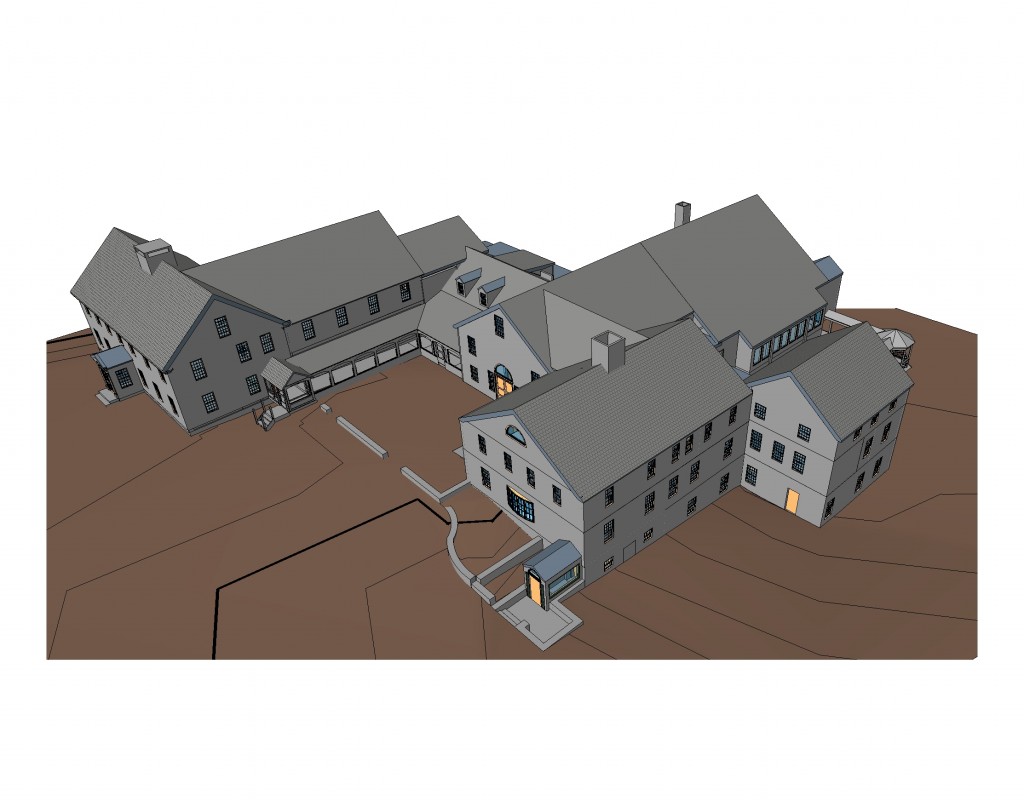
Publick House BIM
BIM As Built : Laser Technology
Posted by Jim Foster in As Builts, BIM, Laser Scanning, New Technologies, Revit on December 1, 2009
Speaking to a colleague from Europe who moved to the US because he stated, ‘there’s a survey shop on every corner in the UK, I could only find a handful here.’ However, that’s changing. HDLS, high definition laser scanning is starting to take off, especially now that the GSA issued the laser scanning awards. Additionally, more and more people are reworking existing assets / adaptive reuse projects so it is becoming more and more important to get the existing conditions data. While everyone is waiting for the day we can walk around with a magic wand and wave it around the room we have to build a bridge from here to there. HDLS in creating a 3D database is an excellent start. I believe HDLS, from firms like Leica and FARO, performs fantastically in certain circumstances such as inaccessible or difficult geometry, exposed MEP intensive projects, however, for typical conditions especially the interior of buildings it might be akin to using a sledgehammer rather when you need a fly swatter. We, PointKnown, have been developing a product that bolts on to Revit and takes laser range finder data and builds objects as you measure. This has been defined as PPLT (Point to Point Laser Technology). It allows a surveyor to move quickly and accurately from room to room or object to object. We do not intend for it to usurp laser scanning but rather augment current surveying teams, allowing them the most flexibility depending on the situation.
Most importantly is to define the deliverable and type of model needed for the project. This can start at the basic architectural model using generic library items to, well , anything goes but most of our clients want dimensionally correct space and then they apply the material and details they need as that is what they want to control.
We are now accepting people and firms into our public beta that starts January 2010, if you have any interest please feel free to contact us at info@pointknown.com and put beta in the subject line.


